Wednesday, May 22, 2013

My Book: How Conservatism Can Rise From The Ashes

FYI, I published the Agenda 2016 book I've been promising. . . here ==>LINK. Please buy it. You can read about it here: CommentaramaPolitics
[+] Read More...

How To Outsmart Your Audience

Modern audiences have become too sophisticated to be surprised. They know all the clichés and they understand the mechanics of storytelling on film too well. But there are some tricks you can use to create genuine mysteries which will keep your audience interested.

Here’s the problem. Audiences understand movie mechanics. If you see something, it matters at the end. A gun in the first frame means someone dies later. When a character tells you something, it will become relevant. If the hero’s father vanished when he was young, you know there will be a mystery old guy who just happens to be the father. Characters also have stereotypical motivations. A businessman will always go for money. A mother will always go for family. Ghosts want their remains given a proper burial. Cocky jocks are cowards or gay. And if a character has a flaw, they will need to overcome that particular flaw to win the movie. . . every single time. This is how films work and audiences know it. That makes it hard to surprise audiences because they can pretty much outline your movie the moment they see the setup.

So how do you get around this? The most obvious solution is to create something new that audiences haven’t seen before. Most of the great films of recent vintage involve new storylines that haven’t been done before. But originality is tricky and dangerous. Audience cling to the familiar even as they claim they want originality. So how else can you surprise your audience? How about this:

A Genuine Twist: Probably the best way to turn a predictable film unpredictable is to give the film a genuine twist. I don’t mean a stupid twist. . . “the bad guy is really your boss! Oh my!” No. Instead, a genuine twist is something that fundamentally changes the nature of the narrative of the story.

Think about what made the twist in Sixth Sense or Fight Club or Usual Suspects so effective. In each instance, the twist change the way the story needed to be viewed at a fundamental level by changing the nature of the character through whose eyes we saw the film. Basically, everything we knew up to that point was suddenly cast in doubt and a whole new meaning was attached to every minute of the film. So long as the story works under both realities (pre- and post- twist), this is the perfect way to create a genuine surprise.

As an aside, the problem with lousy twists like making the main character’s boss be the bad guy is that this does nothing more than solve the supposed mystery. It doesn’t change the narrative in any way that requires a re-examination of what the audience believed to be true.

Twist the Mystery: Unfortunately, coming up with a genuine twist can be difficult, especially in less fantastic genres. So a second alternative would be to start out creating a particular mystery, but then twist that into a second mystery. And example of this might be uncovering a larger force behind the one your characters are initially investigating.

The benefit here is that this adds a surprise to the film right at the point where the film normally has worn out its interest factor. It also lets you raise the stakes, which always helps. Moreover, because this happens later in the film, you can introduce the evidence to support this mystery quicker because you have less run time to fill, which makes the story feel faster paced.

All in all, this doesn’t have anywhere near the power of the genuine twist, but it gives you a way to mislead your audience into thinking they didn’t see the ending coming because they will perceive both mysteries as the same mystery even though the second doesn’t actually begin until late in the film.

Delay: A related version to the idea of twisting the mysteries involves delaying the introduction of the mystery. This is probably best done in comedies where you can roam for a while before you need to start zeroing in on the storyline; in other genres, you run the risk of making the story feel rudderless. Alternatively, you can keep a mystery fresher by delaying the most obvious clues until very near the reveal. This will keep the audience from piecing everything together too quickly, but it runs the risk of making the feel audience cheated because they will feel they weren’t given a fair chance to figure out it.

Twist the Clichés: Finally, we come to one of the easiest ways to make a story feel fresh: embrace the clichés that normally fill your genre, but twist them. An example of this might be to use the gun from the first frame in a completely unexpected way, like having the characters discover that it has no bullets and that they need to find some other solution, or having the obnoxious jock turn out to have the heart of gold, not the hooker. This works because it takes the expected and makes it unexpected. It unsettles the audience’s ability to rely on things they’ve seen in the past as a way to judge how this film will turn out and it puts them in uncharted territory right at the point where they feel they’ve solved the film and will lose interest.

This is one that surprises me that more films don’t do it. It’s a really easy way to both give an audience something familiar but then to surprise them in the end.

Anyway, if you ever do some writing or you want to think about how to improve films that just don’t quite get there, here are some ideas.

Thoughts? What would you add?
[+] Read More...

Tuesday, May 21, 2013

Questionable Jones No. 9

We all know Raiders is just a mess of a movie, right? It needs a lot of changes before audiences will want to watch it.

Question: "How would you change Raiders itself?"

Scott's Answer: I hate to give such a vague answer but I'd trim it by five to ten minutes. I feel it drags a little at times, but only a little, and I don't feel that way about Doom or Crusade.

Andrew's Answer: Huh. Hmm. I can't think of anything, really. Hmm. Ok, how's this. I would change the submarine to a destroyer so people would stop saying Jones would drown. That's really all that comes to mind.

Looks like we need some help with this one!
[+] Read More...

Sunday, May 19, 2013

The Great (film) Debates vol. 81

You know, there's always that moment where you just go too far.

What “shark jumping moment” ruined a film for you?


Panelist: Tennessee Jed

If the question was phrased as "prevented you from seeing a film," I'd say Abraham Lincoln, Vampire Slayer or Cowboys and Aliens. As it is, I guess the first time Roger Moore got to go into space and do battle on a space station. Talk about killing off respect for a franchise.

Panelist: ScottDS

Probably the awful CGI surfing scene in Die Another Day. To be fair, I haven't seen the film in years and I'm usually pretty forgiving with this stuff but my God, what an awful sequence, in both concept and execution (mainly the latter). It's not Pierce Brosnan's fault, though, but it's easy to see why the creators went in a completely different direction with the Daniel Craig films. [This was written before we started the Bond retrospective, but it's still my answer!]

Panelist: T-Rav

Okay, so despite The Day After Tomorrow being totally hackish leftist propaganda and everything, the disaster-movie element of it managed to keep me interested and involved in the action part of the movie—until about two-thirds of the way through. The people at that point are trying to actually run away from the wave of super-cold air like it’s an army or something, which kills you the moment you come into contact with it—that’s not how it works. Then, they’re shouting “Run! Shut the doors!” and then “Burn more books!” Agh. This offends my intelligence on every level.

Panelist: BevfromNYC

I still haven’t seen the 3rd Back to the Future movie because I felt Spielberg just jumped the shark for me. I felt cheated into having to pay for a third one.

Panelist: AndrewPrice

Honestly, Fonzy jumping the shark never bothered me. Anyway, so many sharks, so much jumping... most action films do it in the last twenty minutes. If they did a fourth Indiana Jones movie, I'm sure they would have jumped the shark. They probably would have dropped a nuke on a fridge or something. So what film did I enjoy until it jumped the shark? How about Eraser when Arnold's boss, turns out to be a traitor for no reason that makes any sense. Or even better, Magnolia. It's raining frogs? Are you kidding me?

Comments? Thoughts?
[+] Read More...

Friday, May 17, 2013

Film Friday: The Woman in Black (2012)

Every once in awhile, a movie surprises you. I can definitely say that’s the case with The Woman in Black. Let’s see, we have a low budget, clichéd, Victorian Era haunted house film staring Harry Potter and directed by a newbie. Yeah. This thing had “weak” and “derivative” written all over it. So imagine my surprise to find one of the best horror films in a very long time.

** spoiler alert **
Plot
The Woman in Black stars Daniel Radcliff as Arthur Kipps, a junior lawyer in a Victorian Era law firm who is about to be fired. His wife died giving birth to his son and he’s spent the next five years living aimlessly and distracted. As a last chance, his boss sends him to some podunk village in the middle of nowhere to handle the estate of a woman name Alice Drablow and to sell her house, a creepy place called the Eel Marsh House, which is situated in the middle of a marsh. She had just died.
When Kipps arrives in the village, he finds the locals to be extremely hostile. They all want him to leave immediately. But he needs to finish his job or he will be fired, so he proceeds to Marsh House. As he looks through Alice’s papers, he learns that Alice had a sister named Jennet Humfrye. Jennet was mentally disturbed and blamed Alice and her husband for her son dying in the marsh. They never found the body.
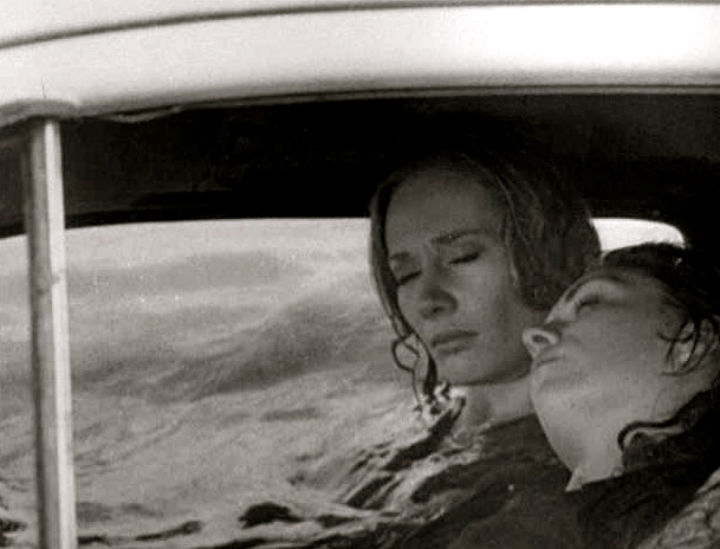
As Kipps works, he starts seeing signs of a young woman. For example, he sees a hand on a window and a shadow run across a room. Doors open and close and a rocking chair moves itself. He then returns to the town for the night. When he gets back to the town, a young girl dies in his arms. She poisoned herself. He then learns that most of the children in this town have died, always of suicides, and the townsfolk hate him because they think he’s started the wave of suicides to begin again. Kipps ignores them and returns to Marsh House where he soon finds himself playing cat and mouse with the ghost of Jennet, who seeks revenge against all she encounters by taking their children from them.
What A Well Done Film!
Ok, here are all the warning signs with this film: Radcliff was still fresh from Harry Potter, and it wasn’t clear he was up to anything else. The film was produced by Hammer, who make cheap and generally kitsch films. Never heard of the director. The critics called the film “traditional to a fault,” which reeks of clichés, and they said it wasn’t scary enough for modern audiences. The Victorian-Era setting also sounded like it would be a problem because we don’t relate to the way they handled their fears. But none of this turned out to be a problem because the director made some brilliant choices.
This film was directed by James Watkins who gets a ton of credit for taking the “creepy imagery” horror story we first saw with the wave of Japanese films like The Grudge and adding a layer of creep to it. He did this in two ways that I think merit discussion. First, he understood that distance adds to the creep factor. Most of the “creepy imagery” horror stories try to scare you by showing you creepy images, like undead kids standing in your living room. But after a quick scene or two, the directors invariably hike up the shock value by having the creature touching the hero or jumping in their face to scare them. While this is effective in stepping up the shock, it simultaneously wipes out the fear-of-the-unknown factor because now we see the thing and we know its intentions and the limits of its powers. All that creepy ambiguity and dreaded potential vanishes. Emotionally, this is the difference between being handed a wrapped gift and being handed an open box.

Watkins does it differently. He spends a lot more time with things happening at a distance. You will see a hand across the room against a window for a brief moment or an empty rocking chair at the other end of the room. You will see a shadow move across the other end of a hallway, a ghost walking toward the house from a grave, and a face appearing a few feet over Kipps’ shoulder. What this does is it gives you a sense that things are closing in on Kipps. That’s ominous and it keeps you thinking, “Run for your life before it’s too late!” By comparison, in The Grudge, your “flight instinct” never activates because you know she can’t escape the thing. Moreover, because of this approach, Watkins never gives us a good look at anything nor do we get a sense of its intentions or its powers until late in the film. That keeps the fear of the unknown running strong within us because we don’t know what the danger really is or how bad it could be. That’s instinctively horrifying to us. Lesser directors simply aren’t willing to be this patient.
Watkins also uses motion very effectively. Strangely, this is something you rarely see in the “creepy image” movies. I think the reason is that those directors focus on creating horrific single images for you to examine and they want you to think about that image, not the action of the scene. Watkins, by comparison, uses motion to show how Kipps is being surrounded. For example, you get to watch a ghost walking toward the house from a grave at one point; you are watching this from the second floor. Think about the horror of knowing that thing just entered the downstairs. Is it coming up the stairs? Has it blocked the exit? That is so much stronger than just seeing an image of the ghost somewhere in the house because it makes you feel that you are now trapped. Remember, when it just appears in the house, you invaded its turf, but seeing it enter the house means it’s hunting you. . . and it’s now between you and the door.

Another shot involves Kipps resting his eyes while he sits in a chair. As he does, we see a long hallway over his shoulder and we see a ghost start down the hallway toward him. . . and us. This is a great idea which builds terror with each passing second and it stuns me that you almost never see anyone do this on film. I don’t know why not. The one complaint I do have about that scene, however, is that Watkins changes the perspective very quickly from watching over Kipps’ shoulder to seeing from the ghost’s perspective. It was an effective scene, but it would have been so much more effective if you had been left to watch helplessly as the thing approached you.
Beyond the creeps, the other thing Watkins does is to keep the film from feeling like a giant cliché. I’ve said before that there’s nothing wrong with clichés if they are handled right. Clichés give us comfort. They are like sign posts of the familiar and they only become a problem if a film merely repeats the cliché as if this is somehow worthwhile. But so long as something new or different is done at critical moments, then the cliché works fine. That’s the case here.

For example, one of the oldest clichés in the book is the outsider who comes to the small village and is accused of bringing evil with them. This film starts that way as well with the villagers shunning Kipps as they believe he has restarted the wave of suicides. The cliché tells us that they will attack him at the worst possible time and thereby ironically help the ghost. Only they don’t. And when they don’t, it feels refreshing because you feel like the director isn’t just going to feed you clichés. The film is full of moments like this, where the cliché doesn’t happen.

Ok, let me add to the ** spoiler alert ** ... I’m going to discuss the ending now. Skip to the conclusion if you haven’t seen the film.

One of the biggest clichés in these films is that when you have a woman ghost, it’s because something happened to her child(ren). And once you reunite the ghost with the body of her missing child, everything ends happily. Of course, that’s after the titanic struggle where the hero gets knocked around by the ghost until the ghost sees the dead body and then rainbows appear. This film starts down that road, but it doesn’t turn out that way. In fact, one of the most refreshing aspects of this film is that it doesn’t devolve into a typical Hollywood CGI-extravaganza at the end. To the contrary, it keeps the feel of the film up to that point, with a low-key ending.
Moreover, I really liked the ambiguity at the very end of the film. My first thought on the ending was that Kipps had failed to solve the problem with Jennet. After all, getting killed along with your son sounds like a loss no matter how you score it. But then I began to wonder. Maybe he actually succeeded. It strikes me that the ending was meant to be positive because you see the family reunited. So either Jennet took her revenge but her revenge was ineffective because she inadvertently made him happy. . . or maybe this was Jennet’s way to reward Kipps? We know that Kipps’ life was meaningless without his wife, so maybe Jennet thought she would reward him by reuniting the family? Keep in mind that Jennet is a bit mental, so this might make more sense to her. Granted, that’s kind of rough on Kipps’ son, but I can’t say that he seems all that unhappy. So I’m left to wonder what the ending really means, but I suspect it means he did solve the problem. In any event, finding that kind of interesting intellectual twist at the end a movie that was much better than I expected, was quite a pleasant surprise.
Conclusion
All in all, this was an excellent film. It looked like it would be a poor film based on a cliché with bad acting and a high chance of a poor director, but it really didn’t turn out that way at all. I enjoyed this thoroughly. It gave me something to think about. It creeped me out at times. And I never once felt bored or disinterested. Is it the best horror film ever? No. But it is one of the best in a good long while.
[+] Read More...

Thursday, May 16, 2013

Questionable Bond No. 6

What good is a villain without quality henchmen? Everybody needs good staff.

Question: "Name the Top 5 henchmen!"


Andrew's Answer: In particular order...

1. Red Grant - From Russia with Love
2. Fiona Volpe - Thunderball
3. Baron Samedi - Live and Let Die
4. Oddjob - Goldfinger
5. Mr. Wint and Mr. Kidd – Diamonds Are Forever


Scott's Answer: In no particular order...

1. Red Grant - From Russia with Love (Robert Shaw in total badass mode)
2. Oddjob - Goldfinger (iconic and still effective)
3. Jaws - The Spy Who Loved Me (until Moonraker turned him into a damned cartoon)
4. Fiona - Thunderball (hot and knows how to ride a motorcycle!)
5. Mr. Wint and Mr. Kidd - Diamonds are Forever (these two are more interesting than anything else in the film, John Barry and Ken Adam's work notwithstanding!)

Honorable mentions...

6. Xenia Onatopp - GoldenEye (this was my first Bond film so call it nostalgia)
7. Baron Samedi - Live and Let Die (featured in the best closing shot in any Bond film)
[+] Read More...

Wednesday, May 15, 2013

Deep Impact (1998) vs. Armageddon (1998)

By ScottDS

In 1999, we had two CGI bug movies. In 1997, we had two volcano movies. And in 1998, we had two “killer asteroid” movies: Mimi Leder’s Deep Impact and Michael Bay’s Armageddon. They both have their good qualities and bad qualities. While the former is a heartfelt, human story set against the backdrop of impending disaster, the latter is… well, it’s what Michael Bay does best – it’s the id to Deep Impact’s superego!

In Deep Impact, Elijah Wood plays high school student Leo Biederman, who discovers a comet that appears to be on a collision course with Earth. Cut to one year later as reporter Jenny Lerner (Téa Leoni) investigates what she thinks is a sex scandal. However, the mysterious “Ellie” in question is actually “E.L.E.” – extinction-level event. Her investigation forces President Beck (Morgan Freeman) to make his announcement earlier than planned: in short, a comet the size of New York City is heading towards Earth. A joint U.S.-Russian spacecraft – the Messiah – has been constructed to intercept the comet and destroy it with nuclear weapons. Leading the mission is veteran NASA commander Spurgeon Tanner (Robert Duvall). Unfortunately, one of the astronauts is killed and the mission fails: the comet splits into two smaller pieces, both on a course for Earth.
President Beck reveals that the US has been building giant underground “arks” and that 800,000 Americans have been randomly selected to join 200,000 pre-selected scientists, engineers, etc. Leo and his family are selected but Leo’s girlfriend Sarah (Leelee Sobieski) and her parents are not. Leo and Sarah get married so that she can come along but her parents are omitted from the list and she decides to stay with them. Jenny gives up her seat on an evac helicopter to a co-worker and visits her estranged father to reconcile. Upon reaching the ark, Leo goes back for Sarah and her family and manages to catch up with them. The smaller comet fragment impacts near Cape Hatteras destroying much of the Eastern seaboard. Meanwhile, the Messiah crew sacrifice themselves to destroy the larger fragment and the pieces break up in the atmosphere. President Beck appears in front of the damaged Capitol building and urges us to begin again.

This is a good movie. At times, it’s a very good movie. The “Ellie”/“E.L.E.” mystery is deftly handled, the characters are decent and likeable people (some more than others), and the pacing is spot on: we’re in and out in two hours. Above all, it’s a human story and the visual effects are the supporting player, not the leading man. This was the second film for TV veteran Mimi Leder, whose previous film The Peacemaker had been released a year earlier. She handles the small moments as well as she does the big ones, ably assisted by executive producer Steven Spielberg who reunites with his Jaws producers Richard Zanuck and David Brown. Unlike today when all the big genre movies seem to share the same half-dozen writers, this movie was written by two guys known for much smaller work: Michael Tolkin (The Player and Rapture) and Bruce Joel Rubin (Ghost and Jacob’s Ladder) – not exactly regulars on the Comic-Con circuit.

Téa Leoni is okay – neither bad nor great – as an MSNBC reporter, back when that network was in its infancy. Morgan Freeman fits the role of president like a glove. Sure it’s a cliché now for Freeman to be “The Authority Figure” but I imagine there was still some novelty to it back then. No doubt more than one comedian has joked about the fact that “we finally get a black president and the world goes to s---!” Elijah Wood is fine as a high school astronomy geek (why do geeks in movies all have Jewish last names?) and, watching the film for the first time in years, I’d forgotten how little he’s actually in it. He disappears for large sections in the middle, but such is life in an ensemble. Robert Duvall is a warm presence as Tanner, nicknamed “Fish.” He’s tough when he needs to be, but also a surrogate father figure for the astronauts under his command.
Vanessa Redgrave and Maximilian Schell play Jenny’s divorced parents, Robin and Jason. This is the kind of subplot that would be non-existent in a movie like this today. Robin is lonely and depressed and Jason is remarried to a much younger woman. Since the aforementioned lottery doesn’t include anyone over 50, Robin kills herself. The reconciliation scene on the beach between Jenny and Jason is nicely done. The Messiah astronauts feature some familiar faces, including Blair Underwood, a young Jon Favreau, and Ron Eldard, who unfortunately is saddled with the arbitrary ageism conflict with Duvall. Admittedly, the scene in which the astronauts say goodbye to their families for the last time brings a tear to one’s eye. Omnipresent character actors like Kurtwood Smith, Richard Schiff, and James Cromwell also make appearances.

Unfortunately, the first adjective that came to mind after finishing this movie was “slight.” Certain things are either rushed or never seen. We never see the construction of the arks, nor do we see the last-ditch effort to destroy the comet with missiles: we only hear about it on the radio after it fails. They can’t show everything but in a movie about the end of the world, sometimes it’s nice for the audience to actually see how we prepare for it. James Horner’s score is treacly to say the least, and ILM’s visual effects are okay. The killer tidal wave (seen in the trailers) hasn’t aged very well. The best effect might be the real traffic jam staged by the filmmakers on Virginia State Route 234, though I could NEVER believe that Leo would actually find Sarah and her family in the middle of it!

And then... Armageddon! There once existed a geek-friendly magazine called Cinescape, before the Internet rendered it obsolete. One issue featured a chart comparing these two movies: Deep Impact was labeled “A sci-fi version of On the Beach” while Armageddon was labeled “Con Air meets The Rock in outer space!” And it is. An asteroid the size of Texas is 18 days away from colliding with Earth. NASA decides to bury a nuclear device inside the asteroid that will split it in two, with each fragment flying safely past the Earth. Since it’s apparently harder to train astronauts to drill than it is to train drillers to be astronauts, NASA director Dan Truman (Billy Bob Thornton) decides to hire the world’s best oil driller: Harry Stamper (Bruce Willis), who brings along his crew of numbskulls. Harry’s daughter Grace (Liv Tyler) just happens to be in love with one of the roughnecks, A.J. (Ben Affleck). The crew undergoes a short and rigorous training program and after an asteroid fragment destroys Shanghai, the plan is revealed to the public.

The crew takes two shuttles – the Freedom and the Independence – and after a seizure-inducing side trip to the Russian space station, Freedom lands safely while Independence is presumed destroyed. Long story short, A.J. and the surviving Independence crew use their mobile drilling vehicle (the “Armadillo”) to reach Harry’s team. During a subsequent rock storm, the bomb’s remote trigger is damaged which means one man has to stay behind. (Naturally.) A.J. picks the short straw but Harry pulls his air hose and shoves him back inside the shuttle. After Harry and Grace say their heartfelt goodbyes, he blows up the asteroid, which indeed splits in two with both pieces dodging the planet. The film ends with home movie footage of A.J. and Grace’s wedding. And, uh... America!! [smile]
Allow me to quote from the Criterion DVD booklet (yes, this movie has a home in that exalted collection). This is Jeanine Basinger, film historian and Michael Bay’s professor at Wesleyan: “It is true that Armageddon, a perfect example of Bay’s work, illustrates his ‘take-no-prisoners’ form of storytelling, in which he trusts an audience to figure things out. (One of its strengths is its minimum of dreadful exposition that over-explains the inevitable pseudoscience.) Yes, it gives audiences a lot to absorb. Yes, it cuts quickly from place to place, person to person, event to event. But it is never confusing, never boring, and never less than a brilliant mixture of what movies are supposed to do: tell a good story, depict characters through active events, invoke an emotional response, and entertain simply and directly, without pretense.”

To quote Jack Benny, “Well!” Truthfully, this movie is Citizen Kane compared to some of Bay’s subsequent work. At this point, he still had Jerry Bruckheimer to keep him under control. Bay’s style might be filmmaking on steroids but in 1998, he was only just starting to overdose! Bruce Willis can often be on autopilot, but here he’s the consummate everyman-turned-hero. Ben Affleck knows exactly what this movie is and he even asked Michael Bay why they couldn’t just train astronauts to drill. Bay’s response? “Shut the f--- up!” This film was also my first exposure to Michael Clarke Duncan and Owen Wilson, who are seen here in their “purest” form: the gentle giant and the likable bumpkin. Peter Stormare is a blast as Lev, the loopy Russian cosmonaut who hitches a ride after the space station is destroyed. Will Patton is Harry’s “aww shucks” sidekick. I used to think Patton was naturally like that but after watching The Postman and No Way Out, I realize he often overacts and this movie is the outlier!

On the Criterion commentary, two NASA gurus spend most of the time nitpicking the scientific flaws, which are many and varied. My biggest problem is this: so the asteroid is the size of Texas but what if a fragment the size of, say, Rhode Island hits the Earth? It’d still be an extinction level event! Oh, and we still have the clichéd scientists versus the military conflict as General Kimsey (Keith David) initiates “secondary protocol” to detonate the bomb remotely, much to the chagrin of Truman. This leads to the requisite bomb defusing scene and shuttle pilot Sharpe (William Fichtner) just happens to have a gun... in space! There’s something to be said about getting the most out of your premise but in a movie about the possible end of the world, these subplots are rather unnecessary. Seriously, a good 20 minutes could’ve been cut from the movie with little to no effect! Technical aspects are top notch all around, including the Oscar-nominated visual effects by the late Dream Quest Images and Trevor Rabin’s “America: F--- Yeah!” score.
This brings up another issue. There’s nothing wrong with blue-collar working-class heroes… but Bay doesn’t have to denigrate scientists to make the blue-collar guys look good. Here’s action movie scholar and author Eric Lichtenfeld: “How hard would it have been to craft a scene where those ideas are introduced, and for logistical reasons, none of them are tenable, and then Bruce Willis and his team are the only option, as opposed to showing why all those ideas are ridiculous? It’s not that the movie can’t have a butch hero stopping the [asteroid]; the problem is that you don’t need to make Bruce Willis look good by making the smart people look bad. It’s a very cynical view of the audience, and it’s a view of science and intellectualism that is full of contempt, but that’s what Michael Bay does when he talks about critics, or his education.” No argument from me!

So what do we have? Two movies about a similar subject, with large ensemble casts, and some heartfelt moments. Deep Impact isn’t exactly subtle but I give 1st place in manipulation to Armageddon. The shot of the kids running with their toy space shuttles past an old poster of JFK? Just... wow. The former was smaller than I’d remembered while, oddly, the latter was just as entertaining (and dumb) as I’d remembered. Deep Impact is the better quote unquote “film” while Armageddon is glorious junk food... and admittedly, 90s nostalgia plays a part here, too.

“The fate of the planet is in the hands of a bunch of retards I wouldn't trust with a potato gun.”
[+] Read More...

Tuesday, May 14, 2013

Questionable Jones No. 8

According to the new Fairness Laws, Harrison Ford has starred in more than his fair share of popular roles. So he needs to give some up.

Question: "Recast Indiana Jones himself."

Andrew's Answer: I can think of a bevy of similar actors from the time (Pullman, Boxleitner, Bridges, Quaid, etc.), but none of them would be right. I like the idea of Liam Neeson, but he didn't get his gravitas until he was too old for the role. Even standby Hugh Jackman just wouldn't be right. So I'm going with a surprise. . . George Clooney. I think he's one of the few actors who can mix arrogance with innocent and tough with struggling and still have the audience really like him.

Scott's Answer: It would be easy to pick Tom Selleck, who would've been Indiana Jones if it weren't for his TV commitments. Instead, I'll go with Kurt Russell. He definitely could do the action adventure stuff, though he may have been a little too young to be believable as a bespectacled college professor. (Maybe if the films were released five years later.)
[+] Read More...

Sunday, May 12, 2013

The Great (film) Debates vol. 80

Everybody need a mulligan sometimes.

What movie needs a reboot?


Panelist: Tennessee Jed

Immediately jumping to my mind is Lincoln by Steven Spielberg. The sooner the better, please. Also, the remake stinker version of The Manchurian Candidate. I have a simple fix for that one, though. Burn all existing copies including digital versions, and replace them with the wonderful original starring Frank Sinatra, Laurence Harvey, and Angela Lansbury.

Panelist: ScottDS

I'd love to see Get Smart given another shot by someone who is actually familiar with the series (and comedy for that matter). I have my own wishlist of things I'd like to see but I'll spare you! I Am Legend also deserves another shot. The Will Smith movie was a colossal disappointment. Fourth time's the charm?

Panelist: T-Rav

I don’t like the idea of reboots on principle. All Hollywood does nowadays is make endless sequels; reboots just encourage them. But if I have to go with one, I would say The Hulk. The Eric Bana one was so bad, and they’ve changed actors I don’t know how many times, so why not? Especially given that character’s renewed popularity since The Avengers, I don’t see how they could possibly do worse.

Panelist: BevfromNYC

I am not sure there are many movies outside the Science Fiction that actually NEED a robot except… oh, you meant REBOOT. Silly me. But more importantly why does the Hollywood brain trust feel the need to “reboot” classic movies? Mildred Pierce was just fine as is. True Grit? Please! Who could do it better than John Wayne?

Panelist: AndrewPrice

I suppose the obvious choice is Star Wars, but they'll probably ruin it. Personally, I'd love to see them do Prometheus again, but this time do it as the story of the engineer they wake up.

Comments? Thoughts?
[+] Read More...

Friday, May 10, 2013

Film Friday: Looper (2012)

Rotten Tomatoes gives Looper a 93% fresh rating and describes the consensus thusly: “As thought-provoking as it is thrilling, Looper delivers an uncommonly smart, bravely original blend of futuristic sci-fi and good old-fashioned action.” Well. . . no. Yes, it is “as thought-provoking as it is thrilling,” but that’s because it registers close to zero on both counts. It’s not uncommonly smart either, nor is it original. Still, I’m going to recommend you see it. Why? Allow me to explain.

** MAJOR spoiler alert **
Plot
Looper takes place in 2044 in what appears to be Robocop’s Detroit moved to Kansas. Crime and drug use are common and people get paid in silver and gold bars for some reason. The story follows a “looper” named Joe (Joseph Gordon-Levitt). A looper is someone who kills people for the mob. Apparently, in the future, it will be nearly impossible to get rid of a body. Why? Who knows, that part of the film isn’t developed. Fortunately for the mob, one-way time travel has been invented. So they send the people they want killed to the past and the loopers shoot them and get rid of the bodies. They are called “loopers” because at some point each looper will be sent their future selves to be killed. At that point, they get a bunch of money and can live happily for thirty years until they are sent back to be shot by themselves. That’s called “closing the loop.”
Joe is a looper and one day he is sent his furture-self (Bruce Willis), but Bruce-Joe gets the drop on Joe-Joe and escapes. So now the mob tries to hunt down both Joe and Bruce while Joe hunts down Bruce to redeem himself with the mob. In the meantime, Bruce is trying to stop a mysterious and powerful person from taking over the mob and closing all the loops, which will result in Bruce’s wife being killed by accident. As Joe hunts Bruce, Joe discovers this mob boss as a kid who comes across like Damien Thorn. Some stuff happens.
Um. . . Yeah
This movie has lots of problems. It is a plodding predictable film that takes place in a bleak but uninteresting setting. Joe is not an interesting or likable character either. Bruce is more interesting, but the film barely delves into his story. There’s no tantalizing look into the future either, and most of what happens in the film feels like it was inserted just to make the plot work. For example, the film is set in 2044, but it might as well be 2012 since the clothing, the buildings, and the cars all look like 2012. BUT, one character just happens to buy a hovering motorcycle. This bike totally feels out-of-place in the film because it is the only “futuristic” vehicle in the film - everyone else drives circa-2012 cars, with Chevrolet’s Silverado featuring prominently. Nor is the bike new, it looks ancient, so there should be others, but there aren’t. So why include the bike? Because a character will need it later in the film.

Similarly, for no reason I can see, the loopers are given guns called “blunderbusses” which are shotguns that only shoot about twelve feet. The other mobsters carry chunky home-made looking revolvers called “gats” which have longer ranges but aren’t accurate - no one in this film can hit the broad side of the barn. It’s never explained why anyone would use these guns instead of the much better guns we have today, but the reason appears to be that the film needed to limit the range Joe could shoot at the end and the accuracy with which Bruce could shoot. That’s it. And don’t think it’s because our guns don’t exist anymore because they do. We know this because Bruce just happens to find a couple (Herstal P90) when he needs a machine gun to take down a bunch of mobsters. Again. . . because he needed it.
Much of the film feels this way, with things getting tossed in only because they make a plot point work. Why does Joe have a drug habit? So the woman he meets will sympathize with him. It’s then forgotten. Why do the loopers kill themselves rather than sending them to another looper? Just to cause the movie. Damien’s powers are the same thing. It’s enough that he grows up to be the guy who causes Bruce’s wife to be killed, so he doesn’t need unique special powers to make the story work. . . but they make the ending work, so he gets them.

It feels like the writer wrote the film backwards. It’s as if he wrote the ending and then decided to plant things in the story to make the ending work: “Hmm, if Joe can shoot farther, then he can stop Bruce. . . better give him a gun with limited range. Ok, so the loopers get guns with limited range. Problem solved.” When a film is full of things that only exist to make the plot work, then you’re dealing with a writer who doesn’t have a firm grasp on his story. Heck, they don’t even need the “close the loop” idea, not with Bruce’s motive to change the past, because Bruce could just hijack the time machine to carry out his mission.

As if that wasn’t enough, the film isn’t thought-provoking either. The film thinks that telling you that time travel can create paradoxes should impress you. Good grief. It also commits the cardinal sin of doing something that’s been done before without adding a new twist. In particular, we discover that Bruce’s wife gets killed because Damien sees Bruce kill Damien’s mother, which starts the circle which leads back to Bruce’s wife being killed, which leads Bruce back to killing Damien’s mother. This is Twelve Monkeys, only not as clever.
The film also tries the “If you met Hitler as a child, would you kill him?” routine, but it adds no new twist. Even worse, it’s mishandled because we’re never sure what is really happening. Joe tells us that Bruce killing Damien’s mother will make Damien evil. Thus, stopping Bruce will stop Damien from becoming Damien. But Damien is pretty clearly already evil. And Bruce’s wife was killed by accident when thugs came to close the loop, which would have happened whether Damien was in charge or not. So the whole thing feels like a fraud. It would have been interesting if the film had played up this uncertainty, but it didn’t. Instead, it basically said, “Look, just accept this, I don’t want to bother explaining it or exploring it.”

What bothers me even more though is that the writer constantly tries to cover the films flaws rather than correct them, i.e. he’s LAZY. For example, the film “cheats” by breaking the paradox so the film can be solved. This is done by showing a guy losing his limbs as his younger self gets dismembered. This should change the guy’s past, but it doesn’t. That means the paradox is not real. YET, the writer has a character tell the audience at that moment that they can’t kill the younger guy because that would change the future. . . as if dismembering him wouldn’t. Basically, the writer is trying to sell you on the false idea that the paradox is still real, even though it can’t be, because without the paradox the ending is nonsense.

If the writer did this only once, then it could be forgiven, but it happens over and over. When you notice that 2044 looks a lot like 2012, a character says, “All you kids today copy the old styles, you should do something original,” as if the set design was the result of some stylized choice rather than budget. When you ask who in their right mind would become a looper knowing they will need to kill themselves, Joe suddenly mentions that “this job doesn’t tend to attract the most forward thinking individuals,” as if anyone lacked that much foresight. The whole movie feels like this. Every time you stumble upon a problem, there is some character there to try the Jedi mind-trick on you. . . “Pay no attention to the fact this is nonsense.”

All of this feels like cheating to me. It feels like nothing in this film is thought out. Nothing in this film is original and nothing will surprise you. Nothing rises to the level of making your brain say, huh, that’s neat. Nothing gets your heart pounding in suspense. Too much time is wasted on passing time. They don’t even handle the few good ideas they have well – there are about three good lines of dialog and five interesting moments and the director fails to exploit all of them. This is a really hard movie to like.
Bonus Round: Why You Might Want To See This Film

Ok, so why am I recommending you see this turkey? Well, there’s an interesting moment in the film. After Joe fails to kill Bruce, the film suddenly and inexplicably shows Joe killing Bruce, and then you follow Joe’s life until he becomes Bruce and gets sent back to be shot. My first thought was that this is just a lousy writer trying to show us Bruce’s story in some cool way that doesn’t actually make sense. But it could be more than that.

Consider this: it is impossible for Joe to solve the paradox the way he does unless there is no real paradox, because otherwise, Bruce would vanish, Joe would have no reason to do what he does, and the whole thing would start over. . . they are called paradoxes for a reason. Anyway, what if the point to the film was that you can’t change your history, but you can change your future. Thus, both Joe and Bruce can alter their own futures, but Bruce’s past can’t be changed. In other words, anything done to hurt Joe would affect Bruce from this point forward, but wouldn’t have affected him in the past. This would fit with the dismembered man. As the young man is dismembered the older version notices the changes in real time, even though they should just have been part of his past. His past also clearly should have changed, but it doesn’t. Perhaps that is the idea hidden inside this film? If so, it is an interesting and original idea.

Sadly, however, I doubt this was the film’s intent. For one thing, it’s not developed or discussed in the film. For another, the evidence upon which this is based could just as easily be more evidence of lazy writing. And since the writer has proven himself to be lazy, it is more likely that he just didn’t have a handle on the loop idea. Still, it’s an interesting possibility. That’s why I recommend at least seeing the film.

Thoughts?
[+] Read More...

Thursday, May 9, 2013

How Diverse Could James Bond Really Get?

Whenever they cast a new James Bond, there is always speculation that this time they’ll pick someone other than a white male Brit. Yet, they keep going back to the same formula. Could there be a black James Bond? How about a chick? What about one with an Indian accent? Good question.

From a story telling perspective, there is no reason that Bond couldn’t be replaced by pretty much anybody. It’s not like the role requires a person of a particular race or gender. The only requirement seems to be nationality because he is a British secret agent. So presumably, anyone could play the role if they brought enough of the other traits. But therein lies the rub.

When you look at what James Bond is, Bond is more than the storylines he tells. Bond represents the masculine ideal. He is essentially everything men aspire to be wrapped up in one stylized package. That suggests that certainly things can’t really be done with the character. For example, you can’t really cast a female James Bond. Sure, in the modern world of action heroes, you get lots of scantily clad females bouncing across the screen. But let’s be honest, those films are aimed at young males who see these women as eye candy. Bond isn’t that. Bond is meant to have broad appeal across age groups and genders. Bond is a hero that males are supposed to see themselves as. If they cast a woman to play Bond, they would lose most of the male audience except for the eye-candy set. They would also lose the female audience who see Bond as the ideal man. They might turn out for the first film with Jane Bond out of curiosity, but they won’t come back for more.

The same problem arises if Bond is made gay. Even fewer men will see the film if Bond is gay because they get no role model and no eye candy. And women may have gay friends, but they aren’t going to see an action film staring a gay hero. . . they don’t really watch action films in the first place.

The other thing Bond represents is an idealized view of Britain. He’s what Britain wants you to think the country is about... ignore the binge drunk girls lying on the sidewalks please. He represents the British upper class if they had balls the way the British upper class like to think they would wage war. This means they can’t cast someone who doesn’t reek of “Queen and Country.” That means no white trash, no foreigners, no one without a stiff upper-lip and the right accent, and no Muslims.

What does this mean for ethnic minorities? Well, right now, Britain is in a tizzy over Poles and Romanians, and seems to see them as some alien “non-white” invaders who are destroying Britain, so I get the feeling that casting anything other than a whiter-than-white James Bond wouldn’t sit too well in Britain. But outside of Britain, I think the world would be pretty accepting of a black James Bond, so long as he seemed upper-crust enough.

In fact, let me suggest a guy who I think would have made an excellent James Bond: Colin Salmon (pictured above). You might know him from Resident Evil, Alien v. Predator and even a couple of James Bond films -- Tomorrow Never Dies, The World is Not Enough and Die Another Day. He’s got the right accent, the sense of class and he’s very, very British. Would he play in Britain? Not sure. Would he play in the “racist” US? Absolutely.

Thoughts?
[+] Read More...

Wednesday, May 8, 2013

Why Defiance Sucks

There’s a new show on the Sci-Fi Channel called Defiance. Yawn. Sorry. As I was saying, there’s a new show on the Sci-Fi Channel called Defiance. It sounded like an interesting premise when the ads first appeared for it, but it’s not. It’s missing the one thing that really matters: a story. In fact, this is the real problem with most science fiction shows these days.

There are many ways you can put together a television series. And often, the approach you pick will depend on your genre. Doctor shows are soap operas, and the degree of outlandishness will very according to how dramatic the show wants to be. Cop shows are episodic mysteries. Lawyer shows straddle the line between soaps and episodic mysteries. Science fiction tends to be episodic or they involve the telling of a particular story arc.

The story arc shows are usually remembered as the best, though sometimes episodic shows can break through. Story arc shows are things like Babylon 5, Lost, Heroes, Carnivale and (eventually) The X-Files. Game of Thrones is like this too. These are shows where the writer has a particular story they are telling, and the episodes typically advance the story to some degree each week. What makes these types of shows so strong is that the story arc gives the show a purpose and a focus and keeps people tuned in to see what happens next. Meanwhile the episode format allows the writers to explore a great many ideas while telling the bigger story. That’s a great combo.

Episodic shows are different. Within the episodic show category, you have two types. You have the morality-tale shows like Star Trek and The Twilight Zone and you have soaps. The morality-tale shows can be really good as they offer the best platform to develop a variety of science fiction and philosophical ideas. Basically, each week you can reach for some new idea and explore it. That can make for excellent viewing.

Then you have the soaps. Yeah. Well. . . at least they’re easy to write.

This is the problem with Defiance. It’s a soap and it follows a formula that promises it will be nothing you haven’t seen a million times. The setup begins, as always, with “the outsider” who arrives in “insert strange setting.” He is the supposed fish-out-of-water who finds himself put into a position where he meets all the movers and shakers in town and must mediate between them. This is a writing crutch for weak writers. It basically makes the outsider into a narrator who can interact in the story. That’s about as easy a way to write a story as humanly possible and it typically means you’re dealing with a writer who is neither creative nor courageous. It also tells you that the series is likely to be worthless. Why? Because rather than telling some story, this setup involves throwing characters together with supposed pre-built conflicts who then repeat generic storylines from prior shows like Eureka week after week as the writers hope that the actors can win over the audience with their own personalities. Basically, they are selling you the actors. It’s hard to like a show like that.

I truly wish that someone would start producing real science fiction -- either with genuine story arcs or in the smart episodic format. Science fiction needs to drop the soap format. . . it’s killing the genre.
[+] Read More...

Tuesday, May 7, 2013

Tuesday Top 5

More stuff ranked just because we can! Let's do another Top 5!

Question: Who are your Top 5 Historical American Personages?

Scott: In no particular order...
1. Teddy Roosevelt -- "A typical vice of American politics is the avoidance of saying anything real on real issues."
2. Abraham Lincoln -- "Be excellent to each other... and party on, dudes!"
3. George Washington -- "It is far better to be alone, than to be in bad company."
4. Ben Franklin -- "Hunger is the best pickle."
5. Thomas Edison -- "I never did a day's work in my life. It was all fun."
Andrew: Interesting. We didn't really define this so I'm taking it as people I'd want to meet.
1. Ronald Reagan -- Our greatest President.
2. Mark Twain -- Our greatest wordsmith.
3. Teddy Roosevelt -- American's Blowhard in Chief.
4. Steven Spielberg -- I'd ask what happened... you used to be cool!
5. Abraham Lincoln -- Our greatest vampire slayer.
There you go... the definitive answers. No doubt, you agree.
[+] Read More...

Friday, May 3, 2013

May Day Open Thread Comrades

With pre-May Day upon us, we're doing what all good socialist workers do... taking the day off. In meantime, comrades, tell us your favorite films of the glories of the Soviet Union and world socialist revolution. Or if that doesn't excite you, tell us what television shows you think should be adapted to film!
[+] Read More...

Thursday, May 2, 2013

Questionable Bond No. 5

As realtors will tell you... location, location, location. A good location can make a film that much better.

Question: "What was the best Bond location?"


Scott's Answer: Given that I live in Florida, I'm in no rush to get to another tropical locale. Instead, I will go with either St. Petersburg (GoldenEye) or Venice (From Russia with Love, Moonraker, and Casino Royale).

Andrew's Answer: My favorite location is hands down Istanbul from From Russia With Love.
[+] Read More...

Wednesday, May 1, 2013

Guest Review: Animal Crackers (1930)

by ScottDS

“Zany” is not a word I use often (or ever) but it’s probably the best word to describe the Marx Brothers. Groucho, Harpo, Chico, and Zeppo got their start on the vaudeville stage, found success on Broadway, and later transitioned to movies. 1930’s Animal Crackers was their second film, based on the 1928 play written by George S. Kaufman and Morrie Ryskind with songs by Bert Kalmar and Harry Ruby. Oh, and it’s also hilarious!

Rich widow Mrs. Rittenhouse (Margaret Dumont, who else?) is throwing a lavish party at her Long Island mansion. Groucho plays the guest of honor: Captain Jeffrey T. Spaulding (the “T” is for Edgar), a famous explorer who has just arrived from Africa. Zeppo plays Jamison, his secretary. Chico plays Ravelli, a musician who haggles with Spaulding over how much it’d cost not to play. Harpo shows up simply as “The Professor” (of what?). Also in attendance is art snob Roscoe W. Chandler (Louis Sorin) who will be exhibiting a famous painting, Beaugard’s After the Hunt. Mrs. Rittenhouse’s jealous neighbor Mrs. Whitehead (Margaret Irving) hatches a scheme with her friend Grace (Kathryn Reece): assisted by Mrs. Rittenhouse’s butler Hives (Robert Greig), they will replace the painting with Grace’s art school forgery, thus making a fool of Mrs. Rittenhouse. Meanwhile, Mrs. Rittenhouse’s daughter Arabella (Lillian Roth) is in love with starving artist John Parker (Hal Thompson) and they come up with an idea: replace the painting with a copy he made in Paris. Chandler will pay him a large commission after seeing how talented he is, and John and Arabella can be “married and divorced in no time.”
Most of these plot details are meaningless – it’s just an excuse to let the Marx Brothers run wild with their dexterous wordplay, physical gags, and all-around anarchy. This was their second of five movies made for Paramount. Once they moved to MGM, studio guru Irving Thalberg made them include more traditional tropes like “romantic subplots” and “sympathetic characters.” But here, it’s all fun and games, with the painting acting as the MacGuffin. Groucho’s future theme song “Hooray for Captain Spaulding” makes its debut here, as does Harpo’s blonde wig (he wore a red one in their previous film, The Cocoanuts) and Chico’s signature tune “I’m Daffy Over You.” As per usual, Chico is obsessed with food: his first line is “Where’s the dining room?” and during a bridge game when Mrs. Rittenhouse says they play for “small stakes,” Chico asks, “And French-fried potatoes?” Harpo is often seen chasing after an attractive blonde and frequently offers up his own leg to people as a salutation. Zeppo, who only made five films with his older brothers, is the straight man. He doesn’t get the girl but he does get a classic scene wherein he writes a letter dictated by Groucho. (More on this later).

I’m not the guy to analyze these movies for their serious themes and socio-political subtext. I’ll leave that to the armchair deconstructionists! For me, the Marx Brothers represented pure id: they say what they mean, they don’t care about social conventions, and they always come out on top, usually in spite of themselves. They’re not mean-spirited and, for the most part, they only pick on people who deserve it. I once showed a friend Duck Soup wherein Chico and Harpo make life miserable for a lemonade vendor. This guy didn’t do anything and my friend was right to label Chico and Harpo “sociopaths.” But in this movie, their target is Chandler, the pompous art patron who has some secrets of his own. Chico says Chandler looks familiar, and then accuses him of being a fish peddler named Abe Kabibble. (This name is based on a comic strip character, Abie the Agent, and was the source of James Bond producer Albert R. Broccoli’s nickname “Cubby.”) Groucho also gets a scene with Chandler, which gets more absurd as it goes on. At one point, Chandler accidentally refers to Captain Spaulding as “Captain Chandler,” causing Groucho to break the fourth wall and ask for a program.
Andrew and I once discussed why too many characters in comedies today aren’t as sympathetic as the characters played by Bill Murray and his cohorts 30 years ago. Aside from acting skills, the characters in those comedies were usually upwardly mobile. They had a plan: make money, get married, etc. The Blues Brothers wanted to save their orphanage, Peter Venkman wanted to see his new ghost-busting business succeed, etc. A lot of characters today are content to sit around and do nothing, blaming society for their failings. Or they buck the system and succeed with no consequences. In these films, the Marx Brothers usually recognized who needed their help – the lovelorn couple, for instance – and who deserved their scorn – the pompous, the phony, and the hypocritical. But they were pro-active and as much as they winked at the camera, they were also sincere. To a point anyway. Groucho might profess his love for Dumont but at least he’ll admit he’s in it for the money!

Also, too many comedies today – especially those awful ____ Movie spoofs – mistake pop culture references for jokes. The Zucker-Abrahams-Zucker team had a name for this: “Knocking Down the Posts.” In other words, “It's not enough to set up a parody, you have to do the jokes. In Airplane!, mere recognition that the girl chasing the plane was a spoof of a particular movie (Since You Went Away) was not in itself funny. The laughs came only when she began Knocking Down the Posts.” One of the most bizarre scenes in Animal Crackers features Captain Spaulding flirting with Mrs. Rittenhouse and Mrs. Whitehead. He then proceeds to have a “strange interlude” in which he recites a serious monologue that ends with stock quotes. This is a parody of Eugene O’Neill’s 1928 play Strange Interlude which featured the same device. There are also lighting-fast references to The Beggar’s Opera, Fuller brushes, vaudeville actor Chic Sale, and a then-controversial book titled The Companionate Marriage. These references work in context and are rarely acknowledged as gags – they’re simply part of the conversation.

The gang gets in some great physical schtick as well. Groucho faints when Chandler points out a caterpillar on his lapel. Harpo starts shooting at the guests as soon as he arrives. Harpo and Chico play bridge with Mrs. Rittenhouse and Mrs. Whitehead wherein Hives attempts to set up a card table but Harpo keeps kicking its legs up, Chico and Harpo contort themselves on a couch, and Harpo repeatedly punches Mrs. Rittenhouse in the stomach! Chico’s reply: “He thought it was contact bridge.” In yet another case of Chico mangling the English language, he reminds Harpo to “scrumble” up the cards. Chico also gets some time in at the piano. As he plays, he admits that he forgets how the song ends, then realizes he went past the ending, then boasts that he once kept this up for three days. Harpo also gets in on the piano (and harp). He spins the piano seat and sits, waiting for the seat to reach him. Chico plays The Anvil Chorus which causes Harpo to go crazy and Groucho to use a woman’s leg for musical accompaniment. One note about Chico: while his Italian accent was obviously fake (and even questioned by Chandler), Italians loved him – they enjoyed seeing “one of their own” get the better of his WASPy superiors.
Groucho delivers one of his most famous monologues in this scene, featuring the now-classic joke, “One morning I shot an elephant in my pajamas. How he got in my pajamas, I don’t know.” His next lines are, in my opinion, equally funny: “We tried to remove the tusks but they were embedded so firmly, we couldn’t budge them. Of course, in Alabama the tusk-a-loosa. But that’s entirely irr-elephant to what I was talking about.” He follows up with a line that I’m surprised made it past the censors: “We took some pictures of the native girls but they weren’t developed. But we’re going back again in a couple weeks!” Groucho later has Zeppo take down a letter to his lawyers: the Honorable Hungerdunger, Hungerdunger, Hungerdunger, and McCormick. The letter is full of out-of-context business jargon (“i.e., to wit, e.g., in lieu”). Ultimately, in a typical sign of Marx logic, Groucho tells Zeppo to make a carbon copy and throw the original away, then to throw the carbon copy away and just send a stamp. The joke has now closed in on itself.

Oh, in case you were wondering about the plot, Chandler encounters both art forgeries and decides that John Parker’s work is excellent. A happy ending for the young couple! The film itself is rather anti-climactic… disappointing considering the stage version ended with a lavish costume ball. The brothers walk into the scene singing “My Old Kentucky Home.” Police Inspector Hennessey (Edward Metcalf) tries to arrest Harpo for stealing the original painting (he and Chico had swapped the paintings earlier), but Harpo pulls out a Flit can and renders everyone unconscious. He then sees the blonde he was chasing earlier and knocks himself out, landing in her arms.
The Marx Brothers are not for everyone, but anyone who wants to go into the comedy business would be wise to study them: don’t treat your audience like idiots, don’t be mean-spirited unless there’s a point to it, inactivity is anathema to good storytelling, and either every cow is sacred or none of them are. (Said the graphic design student with no comedy experience, save for improv classes!)

As a child, I thought of this movie as “the boring one” but watching it as an adult, it’s one of my favorites. (Here’s a cool annotated guide!) It’s actually one of the longer Marx Brothers movies (at 97 minutes – only A Day at the Races with its interminable water ballet sequence is longer) but it really flies by, despite its stilted, stage-bound direction. I will now close with a question Spaulding asks Chandler after pummeling him with another rambling speech:

“Now, uh, you tell me what you know.”
[+] Read More...

Tuesday, April 30, 2013

Tuesday Top 5

Because we can never rank enough stuff, let's do another Top 5!

Question: What are the Top 5 board games?

Andrew: I know what you're thinking. Ok, actually I don't. Here are my answers.
1. Chess -- the brainiest of games.
2. Clue -- Miss Scarlet in the bedroom.
3. Risk -- Canada should belong to the US... to complete the set.
4. Life -- the game about unexpected pregnancies, the risk/rewards of insurance, and lottery winnings.
5. Trivial Pursuit -- the game which gives meaning to the meaningless.
Scott: In no particular order...
1. Monopoly -- a classic!
2. Checkers & Chess (tie) -- I never got into chess but I'm always up for a good game of checkers.
3. Scrabble -- when in doubt, you can always use "the".
4. Clue -- Mrs. Peacock in the library.
5. Risk -- hilariously referenced in a Seinfeld episode.
There you go... the definitive answers. Wait a minute, what about Hungry, Hungry Hippos?
[+] Read More...

Sunday, April 28, 2013

The Great (film) Debates vol. 79

First impressions are a powerful thing, and in films they set the tone for the whole film.

What film has the best intro?


Panelist: BevfromNYC

Duh, Gone With The Wind. Nothing more needs to be said.

Panelist: ScottDS

This one's a tough one but you know what intro immediately gets me into the movie? The opening of Lethal Weapon 2. We're literally thrown right into the action with Riggs and Murtaugh, mid-car chase with their fellow officers. (The Looney Tunes fanfare over the WB logo helps, too.) The usual mayhem, lights, sirens, fleeing civilians, a helicopter, property damage... it's all very exciting and just fun to watch! (I actually prefer this film to the first one.) "Diplomatic immunity!"

Panelist: T-Rav

I don’t know if I would call it the “best,” but I really like how Pulp Fiction begins. At first you think Rango (that’s his name, right?) and Yolanda are planning a crime, then you’re led to believe “oh, they’re just talking hypothetically,” and then turns out they really are about to rob the joint. It’s a great metaphor for the movie in general, when you think about it; confusion and misdirection only gradually becoming clear.

Panelist: AndrewPrice

Star Wars. 'Nuff said. Seriously, you see a planet, you are told there will be a cool story, then you are blown away by the big honking star destroyer that is about to blow away the rebel ship. That scene sets up the entire movie and tells you everything you need to know about both sides.

Panelist: Tennessee Jed

Recognizing that films viewed more recently have a built in advantage, I offer up the following three films whose intro's all had a huge impact on me (starting with most recent) - Inglorious Basterds, Mulholland Drive, and From Russia with Love. As for the latter, admit it, when you looked down at the face of Connery lying dead in the garden, they had you going for just a second. :)

Comments? Thoughts?
[+] Read More...

Friday, April 26, 2013

Film Friday: Zulu (1964)

Zulu is one of my favorite films. It’s a war film about the 1879 Battle of Rorke’s Drift between a small detachment of British soldier at a farm in South Africa and an army of Zulus. It’s one of those films that does everything right.

** spoiler alert **
Plot
Zulu is an historical war drama about the Battle of Rorke’s Drift. On January 22, 1879, the British Empire invaded Zululand. Eleven days later, a force of 20,000 Zulu warriors attacked a British column of 1,800 soldiers. The Zulus overran the column and killed 1,300 British. A few days later, a force of 4,000 Zulus moved against nearby Rorke’s Drift, a farmhouse where around 150 British soldiers had set up a field hospital. This is where Zulu begins.
As the Zulus surround and attack the field hospital, the British inside put up a series of defenses. Between attacks you get to know the soldiers and you see their true characters emerge. You’ve got the dissenter who turns out to be a hero (Private Henry Hook – James Booth). The hero who thinks he’s a coward, but really isn’t (Lt. Bromhead – Michael Caine). The every-man who uses his brain and his will to save the unit (Lt. Chard – Stanley Baker). You’ve got a conflict with a minister (Rev. Otto Witt – Jack Hawkins) who wants them not to fight. You’ve got conflict between the commanders. You’ve got conflict between the soldiers. And you have a relentless, courageous and powerful enemy. The film ends in a draw, with the Zulus saluting the British soldiers’ bravery.
What Makes This Film So Interesting
This film is interesting on several levels. First, you have the cast. Baker was a rising star who had been offered the role of James Bond in Dr. No, but was forced to turn it down. He died a few years after this film at the age of 48. Richard Burton does the narration. This was Michael Caine’s first starring role, and he almost didn’t get it. He had tried out for a different role before trying out for Bromhead. His screen-test went so poorly that Baker (who produced the film) wanted to replace him, but it was too late as shooting was scheduled to begin. The leader of the Zulus was played by Mangosuthu Buthelezi, who some of you might recall as the actual leader of the Zulu nation in the 1980s - he founded the Inkatha Freedom Party and allied himself with white South Africans against the ANC.

As an aside, due to apartheid laws, none of the Zulus could be paid for appearing in the film, so the director left them cattle as gifts.
Secondly, this film respects both sides. One of the reason most modern war films feel hollow even though their effects are great is because the enemy is typically presented as cardboard. Be the enemy Arabs, giant bugs, robots, or Nazis, the enemy is no longer humanized in Hollywood. That robs the audience of any sense of realism. Basically, instead of seeing this a struggle between real people, where both sides put their lives on the line for what they believe in, you get a videogame where you watch supermen take down pixilated enemies. Even worse, since the enemies are no longer real people, Hollywood allows the supermen to kill them in droves to keep the audience entertained. This robs the heroes of their achievement. They are no longer mere mortals struggling and overcoming a powerful, believable, well-matched or overwhelming enemy, they are characters in a shooting gallery taking down the enemy at will.
Zulu was before all of that. In Zulu, the Zulus are courageous and dangerous. This is no simple fight and there is a really good chance the British will fail. In fact, you keep wondering throughout how in the world they will prevail, and the film reinforces this by showing that the British are reaching the end of their rope as the film nears its climax. That makes the ending truly spectacular. Indeed, the climax isn’t a battle, it’s a non-battle as the Zulus do a show of respect for the British rather than attack, and then they withdraw. That adds a really strong emotional punch to the film. Not only are you shocked (and relieved) that the climax you expected didn’t come, but you feel a sense of pride that both sides have earned the others’ respect. It makes you feel like you watched something truly special, i.e. a battle between the best. It also lends an air of authenticity to the film (even though that didn’t happen in real life) because it makes you realize that these were real people on both sides. War film should go back to this idea, because it really works.

The final aspect of this film which makes it so interesting are all the messages throughout and how subtlety they are delivered. Moreover, while the film was directed by Cy Endfield, who was blacklisted in Hollywood, and it intended to lean left, it almost seems more libertarian. Consider this.

● The film presents an anti-empire message. It does so by showing that the carnage proves pointless and by making it clear that no one seems to know why they are in South Africa, except Chard who is there to build a bridge. At the time, this would have been seen as a message of the left, which was anti-empire and embracing the anti-war movement. However, this rings more libertarian right than progressive left, as the modern left seeks to impose their beliefs on everyone. Indeed, the left were big on empire building throughout history, except for the brief moment when they wanted the British Empire dismantled. And even that was quickly replaced by leftist intervention from the Soviets and their allies, and from Western-leftists pushing their beliefs on indigenous people. Really, the only people saying we should leave everyone else alone to live their own lives are American libertarians.

More interestingly, this message and the anti-war message are only hinted at throughout the film, with characters asking why they are here and finally with Bromhead being disgusted at the carnage he sees – aside from this, there are no speeches, no lectures, and no demonizations. This actually makes these messages amazingly effective because it leaves it up to the audience to reach their own conclusion based on what appears to be a simple presentation of facts rather than arguments. This makes a stronger message because people feel that they reach the conclusion on their own and it takes away the sense that the messages are propaganda.
● The film also makes an anti-elite message where the effete upper-class Bromhead proves to lack the competence of the blue-collar Chard. Bromhead stands in as the representative of the British upper crust. He is stiff, smug, and arrogant. He can tell you his heritage back before time began and he sees himself as the descendent of the heroes who shaped the world. But he’s also incompetent and cowardly. Chard is a mutt. He has no background, he’s clearly middle-class, and he got here on skill alone. He is an engineer, a profession you must earn rather than inherit, and he quickly proves to be everything Bromhead is not – thoughtful, competent, brave, and a solid leader. The message here is very anti-elitist and pro-meritocracy. At the time, this would have been a leftist message as they wanted to topple the existing power structure, but in hindsight, this is highly libertarian. Indeed, meritocracy is a conservative/libertarian idea, with the left favoring rule by elites and elite-appointed experts.

As an interesting aside, there have been suggestions that Bromhead may be homosexual based on certain behaviors he exhibits, particularly being “foppish” with a whip. I cannot say if this was truly intended, but it does seem to be suggested as a further reason to look down on Bromhead, i.e. the idea that the elite are abnormal and perverted – another interesting flip for the left.

All of this makes for a truly fascinating film. The film is beautifully shot, having been filmed in national parks in South Africa. The costumes are perfect. The acting and writing is excellent, and it’s neat to see Michael Caine in his first major role. The interaction of the soldiers is believable and not at all cliché. The messages are powerful and they are made all the more powerful because you are left to reach them yourself. And ultimately, this is a heck of a war film because the enemy isn’t downgraded to cartoon status so you’re never really sure if the heroes can prevail. It is a tense film.

I highly recommend this film.
[+] Read More...

Thursday, April 25, 2013

Bond-arama: No. 0019 The Living Daylights (1987)

Today we continue our journey through the James Bond films with No. 0019 of 0023: The Living Daylights. This was Timothy Dalton’s first Bond film and it’s a very small movie. This film was meant to bring realism back to James Bond and explore his darker side. It didn’t. Instead, they created a film which felt small all around – small Bond (not larger than life), small-time villains, small-time plot, small sets confined to small areas. Even when Bond travels, you never get the travelogue feel of prior Bond films. Small, small, small.

Plot Quality: The Living Daylights begins with a bit of intrigue. During a mock 00-operative invasion of Gibraltar, some bad guy kills 004 and then nearly kills Bond. This leads to the discovery of something called Smert Spionam (“Death to Spies”). The scene then shifts to Czechoslovakia, where 007 has been assigned to protect KGB General Georgi Koskov (Jeroen Krabbe), who is planning to defect. Bond shoots the female cellist (Maryam d’Abo) who was assigned to assassinate Koskov if he tries to flee. But Bond doesn’t kill her because he recognizes her as an amateur. Bond then smuggles Koskov out of Czechoslovakia into Austria through a pipeline. This is the best part of the film, even though it is a small idea involving few people, low stakes and confined sets. It also involves an annoying trope – the inept bureaucrat who despises Bond being called in to handle “his” operation.
When Bond returns to Britain, he meets with Koskov, who is being debriefed at a safehouse. Koskov warns MI6 about Smert Spionam, an operation supposedly being run by the new head of the KGB, Gen. Pushkin (John Rhys-Davies), to assassinate British spies. Koskov claims this could start a war between the Soviets and the West. Koskov is then kidnapped from the MI6 safehouse. This is where the problems start with the film. For one thing, it’s not obvious how killing spies could lead to war – who goes to war over a dead spy? For another, the film now gets needlessly complicated with a series of double and triple crosses, which seem like they are included merely as filler.

Bond is ordered to kill Pushkin to stop this Smert Spionam operation and avenge the death of 004. Bond, however, decides that Pushkin would not have ordered this operation, so he confronts Pushkin, who tells Bond that Koskov is under investigation for embezzlement, which makes Bond realize the defection was faked by Koskov so he could trick MI6 into killing Pushkin for him. Bond then decides to track down the cellist, whom he believes helped Koskov fake his defection. Naturally, she falls for Bond and he escapes with her. Bond then returns to Tangier to find Pushkin, but Bond gets kidnapped by Koskov and taken to Afghanistan. There he meets the very westernized Mujahedeen. He then steals a Soviet military transport which Koskov is using to smuggle opium to enrich himself and an American arms dealer named Whitaker (Joe Don Baker). Bond saves the cellist and showers the countryside in opium. Then he goes to Tangier to kill Whitaker and Koskov. He kills Whitaker, but Koskov ends up being arrested by Pushkin, who will extract revenge. The film ends with the grateful Soviets letting the cellist leave for the West so she can play for Western audiences.

Unfortunately, despite this dizzying travel schedule, the audience never really gets a sense of travel in this film because the film never ventures out of closed sets, except at the Russian airbase in Afghanistan – and all you see there is dirt. This keeps the film small, as does the evil scheme. Indeed, ultimately, this scheme boils down to a guy looking to skim profits off a drug deal. This is hardly worthy of James Bond, especially because there are no real consequences if he doesn’t succeed. . . some opium gets to Europe. Big deal. They get all they want already. Moreover, the climax moment in the film is a fight between Bond and Koskov’s henchman Necros on an airplane. . . not even between Bond and Koskov himself. Again, small thinking.

Finally, as with License to Kill, there aren’t really any iconic moments and there aren’t really any memorable quotes. This isn’t a film that makes an impression.
Bond Quality: Timothy Dalton was a bad choice for Bond. With Roger Moore too old to play the role, the producers wanted Pierce Brosnan, but he was contractually bound to play Remington Steele. The next choice of the director and co-producers was Sam Neill, but Albert Broccoli wanted Dalton. Dalton had previously expressed disdain for the role and, frankly, he just didn’t have what he needed. For one thing, this film was meant to show a more realistic and darker Bond, but Dalton really couldn’t pull that off. For while Bond is meant to be cold-blooded, Dalton projects a lot of anger onto the screen. Bond is also meant to be stylish, but Dalton never once makes you wish you knew his tailor.

Dalton also never feels comfortable in the role. This is because Dalton is one of those Shakespearean-type actors who can’t shake his training. If you compare him in this role to his role in The Rocketeer or his role in Flash Gordon, they’re identical. And anyone who thinks you can play James Bond the same way you play Prince Baron just doesn’t understand acting.

The Bond Girl: The Bond girl here was Maryam d’Abo as Kara Milovy, the cellist. She’s kind of passive. She exudes no passion, no mystery, and she has no great motive to be in the film. She’s just the narcoleptic girlfriend along for the ride. Nor do you ever get the sense that she sees Bond as more than just a friend.
Villain Quality: Finally, we come to the villain(s). Yikes. This film has two villains, and neither is worthwhile. First, you have Koskov. Played by Jeroen Krabbe, the villain in The Fugitive, Koskov is not fitting to be a James Bond villain. Essentially, he’s an embezzler who tries to trick James Bond into killing his boss to keep from being discovered. This makes little rational sense and robs the story of any stakes. Indeed, whether Bond succeeds or not, nothing changes for the world. Perhaps realizing this, the writers try to up the stakes by telling the audience that Koskov is trading arms to the Mujahedeen in exchange for drugs, which he will sell in Europe. But how does this help? It’s not like Europe won’t get plenty of drugs either way, and the US was openly arming the Mujahedeen. So what do we care?

Moreover, his plan to get Bond to kill his boss is Rube-Goldberg silly. Does anyone really think the Soviet Union won’t figure out that he staged a fake defection and met with Bond right before Bond killed his boss? The Soviets would need to be retarded not to put those facts together. Seriously, just shoot Pushkin or stage a car accident like everybody else does. Of course, Koskov may be mental because he keeps not killing Bond for no apparent reason. Even worse, throughout the film Koskov comes across as a bungler who kisses everyone’s butt... like the Biff of the James Bond Villain world. This is not a Bond villain, not in scheme, not in personality.
The other villain is Joe Don Baker as Brad Whitaker. Baker is a B-grade actor at best and Whitaker is pathetic. He’s an arms dealer who likes to dress up like a general and play with toy soldiers. He doesn’t really have a scheme either because the writers assumed that the audience would accept the fact that he’s an arms dealer as proof enough of his villainy. Stupidly, his death is essentially treated as the climax of the film, even though he’s a bit player with an uninteresting story not worthy of Bond. In fact, there wasn’t even a reason for Bond to go after him because the cops could have picked him up just as easily.

Neither villain rises to the level of a Bond villain. This is probably why the film’s true climax involves Bond killing Koskov’s henchman aboard the Russian transport plane. And just to add insult to injury on that point, the only cool thing about the henchman is his name “Necros.” He has no other defining traits.

Conclusion

This was a rocky start for Timothy Dalton. The film began well enough, but quickly became a jumbled mess, and there was little to mark this film as a James Bond film: small time villains, small locations, small Bond, small plot, mousy Bond Girl, dated soundtrack. The only thing that wasn’t small was the transport plane fight, and that was too long to stay interesting and it lacked any real stakes. . . it was just a nice stunt. But this film was better than Dalton’s second attempt. That’s why this film is No. 0019 of 0023.
[+] Read More...